Interesting Cyprus Facts
“Some useful information about Cyprus”
A RATHER UNIQUE PLACE
Cyprus is a culturally rich, historically deep Mediterranean island split into the southern Republic of Cyprus, which is a European Union member state that uses the Euro, and the northern area, that although only recognised by Turkey, in all its entirety acts as a separate state. There are several interesting Cyprus facts that all make this island in the sun a rather unique place. Whilst some of these points of interest are more obvious than others, the lesser-known ones are often attributed to the island’s enriched history and culture that spans thousands of years. This Eastern Mediterranean island benefits mainly from Greek influences, and with this in mind, it has several significant ANCIENT ROOTS of mainly Greek origin that have helped forge a unique Cypriot identity.
A RATHER UNIQUE PEOPLE
Although Greek culture and language have prevailed, other notable early civilisations have also influenced the island throughout the ages. These include PHOENICIAN, ROMAN, ANGLO-NORMAN and Medieval orders, such as the KNIGHTS TEMPLAR. The island’s Lusignan Franks, and later the Venetians, also heavily influenced Cypriot culture. The Lusignan order took control of Cyprus after losing their kingdom of Jerusalem during the Third Crusade. Other later influences include VENETIAN, OTTOMAN TURKISH, and then BRITISH administrations, which all ruled the island at some point.
A NEW REPUBLIC
The Republic of Cyprus was formed after Independence from British rule was achieved in 1960. The new era, however, was marred by intercommunal conflict. This occurred after tensions between the Greek and Turkish Cypriot communities across the island led to political upheaval shortly thereafter. This was further fueled by Greek nationalists who wanted a union with Greece and Turkish nationalists who advocated separation. This led to a Greek military coup d’état in 1974, which subsequently resulted in a military intervention by Turkey. This resulted in the occupation of the northern part of the island.
A DIVIDED COUNTRY
Cyprus has remained politically divided since 1974. The brief war with Turkey resulted in the occupation and then division of the island and the creation of a UN-controlled buffer zone, which is also known as the Green Line. The aftermath saw Greek Cypriots from the north repatriate to the south, and Turkish Cypriots in the south repatriate to the north. This division was cemented when the de facto Turkish Republic of Northern Cyprus, which is only recognised by Turkey, was later declared. This created a political stance that still exists on the island today, and Nicosia remains the world’s only remaining divided capital city.
A UNITED NATIONS BUFFER ZONE
The south of Cyprus today makes up the legally recognised Republic of Cyprus, whilst the Turkish-controlled northern part of the island remains an occupied territory only recognised by Turkey. A United Nations buffer zone, known as the Green Line, runs through the Capital city, Nicosia. This remains the last divided city in the entire world. The Republic of Cyprus as a whole joined the European Union in 2004, although membership of the unrecognised north of the island remains suspended. Negotiations for reunification or a lasting settlement have continued for decades. These have come in the form of a constant series of peace talks and various confidence-building measures, with minimal results.
A EUROPEAN COUNTRY
The Republic of Cyprus has been part of the EUROPEAN UNION since 2004. Although divided, the whole country is still regarded as a European Union territory, but as the Turkish-controlled northern part is unrecognised, its membership remains suspended. Cyprus currently enjoys all of the current European initiatives and has become a valued European partner since it joined the bloc. European Union citizens have the right to live and work in the Republic of Cyprus, and travelling to the island is generally straightforward. Visitors from the European Union, the United States of Ameriica, Canada, Australia and the United Kingdom do not need a visa to visit, but a registration certificate is required to legally stay continuously for more than 90 days.
KEY ECONOMIC DRIVERS
Although Cyprus has a diversified economy, its two main industries include financial services and tourism. These form the two major employment sectors across the island, and both of these remain as key economic drivers.
TWO OFFICIAL LANGUAGES
Cyprus, as a whole, recognises GREEK and Turkish as official languages. GREEK is mainly spoken in the Republic of Cyprus in the south, whilst Turkish is mainly spoken in the unrecognised Turkish state in the north. English, which is used in business, education, and signage, is also widely spoken throughout the island.
CURRENCY
Cyprus has employed the use of the EURO as its currency since 2008. Cash and credit cards are accepted almost everywhere, and it is advised to always pay in local currency when using a card. Banks remain closed for the whole weekend, but there are numerous ATMs, which are always accessible. Online banks such as REVOLUT are also widely accepted across the island.
TERRAIN
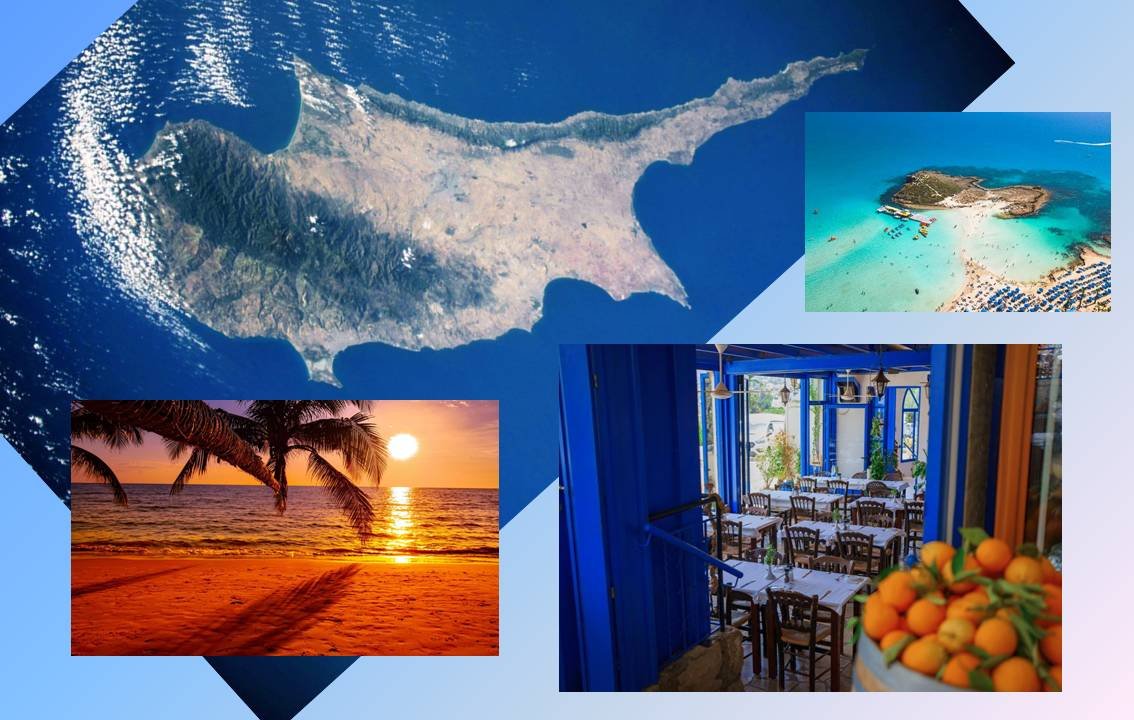
The wider terrain of the island includes a grand mix of rustic mountains, large plains, and a rugged coastline with several beaches. Mount Olympus, which reaches a peak of 1,952 metres above sea-level, provides SKIING Troodos Mountains in the island’s deep interior.
There are several notable natural places to visit across the island. These include the TROODOS MOUNTAINS, THE AKAMAS PENINSULA, and several natural coastal areas such as Cape Greco. The island also benefits from several BEACHES. These include Fig Tree Bay and Nissi Beach in the east and Coral Bay in the west. According to Greek mythology, Cyprus is also the birthplace of Aphrodite, the goddess of love and beauty. Her famous birthplace is believed to be APHRODITE’S ROCK on the coast of Paphos.
SOCKETS & POWER PLUGS
Cyprus operates a standard 50 Hz 240V electric supply. The island also employs the use of type G power plugs and sockets, which are the same three-pin plugs that are used in the United Kingdom. Adaptors and voltage converters may be required for some appliances, but this is dependent on their country of origin.
DRIVING
There are no trains on the island, so public transport generally relies on BUSES. Vehicles in Cyprus are right-hand drive. This means that they are driven on the left-hand side of the road, and generally follow United Kingdom driving rules. SPEED LIMITS, which are enforced by island-wide TRAFFIC CAMERAS, are a maximum of 100 km on motorways, 80 km on other dual carriageways and 50 km in built-up areas. Convenient and reliable CAR HIRE is readily available across the island for those who want to explore rural villages, mountain trails, and remote beaches at their own pace.
SEVERAL UNESCO SITES
Cyprus is home to several UNESCO World Heritage Sites. These include Important ancient cities, such as Kourion, Salamis, and Paphos. There are also several Medieval buildings, which include castles and forts that can be found across the island.
TEMERATURES
Although Cyprus has mild winters and hot summers, with very low rainfall, TEMPERATURES do vary on the island. The favourable Cyprus climate is made up of long, hot, dry summers and mild, wet winters. Coastal areas tend to be slightly milder than the interior during the winter, but the interior usually benefits from more favourable temperatures during the hot, dry summers. The time of year and area of the island both determine annual temperatures. Coastal areas generally receive warmer TEMPERATURES, whilst inland areas receive lower temperatures. The coolest place on the island is the summit of the Troodos Mountains. All areas leading up to this point generally receive a cooler climate all year round.
Winter: The mild winters generally see temperatures drop to between 15 to 20 degrees in most coastal areas. Inland temperatures are usually 5 degrees cooler than those of the coastal areas, but the summit of the Troodos Mountains often drops to below zero. This means that there is ample snowfall that provides for winter skiing. Temperatures usually drop a further 5 degrees over night.
Autumn: Temperatures generally peak between 25 to 30 degrees in most coastal areas. Inland temperatures are usually 5 degrees cooler than those of coastal areas. Temperatures usually drop a further 5 degrees during the night.
Spring: Temperatures are similar to the autumn periods and generally peak between 25 to 30 degrees in most coastal areas. Inland temperatures are usually 5 degrees cooler than those of coastal areas. Temperatures usually drop a further 5 degrees during the night.
Summer: Temperatures generally peak between 35 to 40 degrees in most coastal areas. Inland temperatures are usually 5 degrees cooler than those of coastal areas. Temperatures usually drop a further 5 degrees during the night.