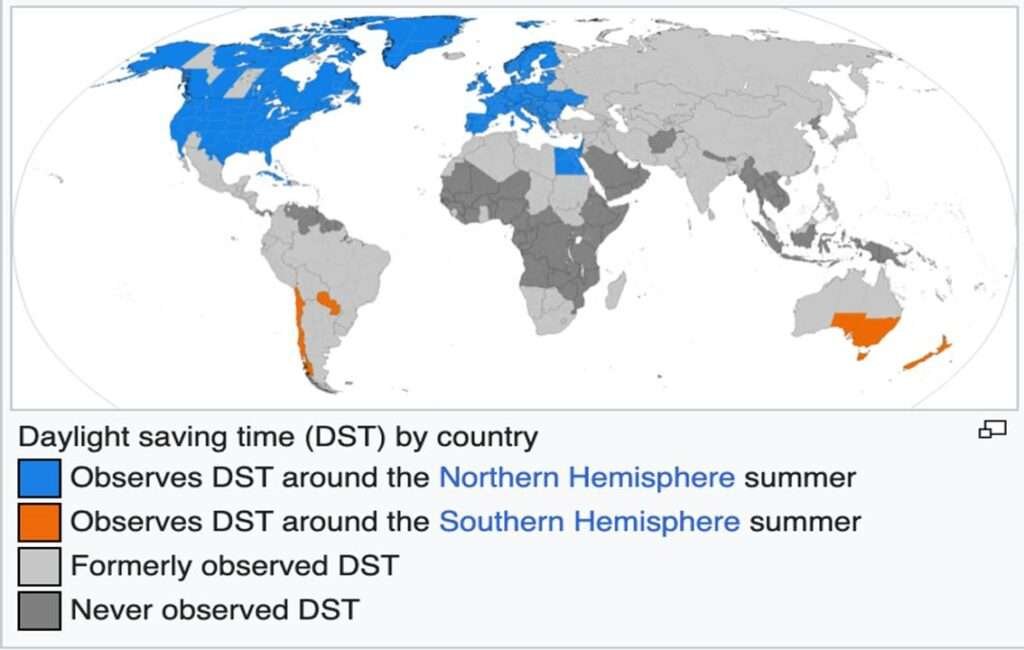
Daylight saving time is the practice of advancing clocks twice a year. This is done to make better use of the longer daylight during the summer months. Currently observed for over 100 years across Europe, the practice of advancing clocks so that darkness falls at a later time has now become the norm.
In Cyprus, the clocks change twice a year on the last Sundays of both March and October. On the last Sunday of March, clocks move forward by 1 hour at 03:00 am local time, starting daylight saving time, and on the last Sunday of October, clocks move back by 1 hour at 04:00 local time, ending daylight saving time. All smartphones, tablets, and computers normally update automatically, but mechanical and analogue clocks must be adjusted by hand.
Cyprus uses Eastern European Time in standard time and Eastern European Summer Time in daylight saving time. This typically runs from spring to autumn, aligning Cyprus with neighbouring regions that also use EET/EEST, including nearby Greece and the broader European Union.
As a result, daylight saving time in Cyprus comes into effect on the last Sunday of both March and October.
On the last Sunday of March, all clocks are advanced by one hour at 3.00 am local time.
Daylight saving time then remains in effect until the last Sunday in October, when all clocks are reversed by one hour at 4.00 am local time.
MAKING BETTER USE OF DAYLIGHT DURING THE SUMMER
Daylight saving time in Cyprus
Although the implementation of daylight saving time has become standard practice for several European countries, it is a topic of much discussion within the European Union. Arguments both for and against exist, and these have been put to the European Commission on numerous occasions. This has prompted several European officials to propose abolishing it altogether on numerous occasions.
Despite this, there are currently no immediate plans to change anything. This, however, has not stopped the debate, and several arguments against the current system are found to be constantly raised. Several sceptics remain in favour of abolishing daylight saving time altogether. They want to replace it with a new universal standard time system.
Others, however, maintain that the current system simply works fine. They have stated on numerous occasions that a system of universal standard time will not create more daylight hours for summer recreation. The debate, which remains open to discussion, rages on!