A look at traditional Cypriot pottery
AN IMAGINATIVE LOCAL AESTHETIC
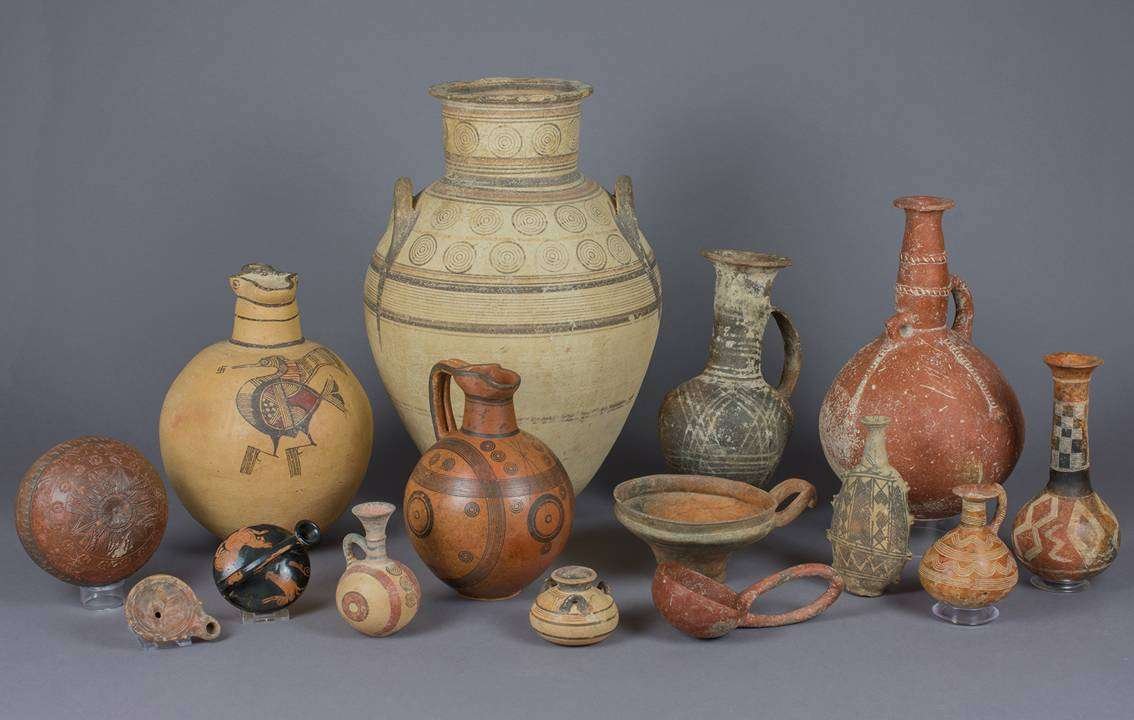
The pottery of ancient Cyprus spans thousands of years, evolving from the early Stone Age through to the Classical era. Sitting at the maritime crossroads of Europe, Asia, and Africa, ancient Cypriot potters developed a highly distinct, incredibly imaginative local aesthetic. While neighbouring regions of the island often focused on rigid uniformity, Cypriot artisans instead produced uniquely playful, hand-formed shapes decorated with bold geometric lines that detailed vibrant animal motifs.
EARLY FORMS OF STONE POTTERY
Several examples of pottery etched from stone have been unearthed from the early Neolithic Period. This is when people are thought to have first begun settling across the island. Ceramic pottery, in a conventional sense, is thought to have existed much later, and it was at this stage that Cypriot potters across different parts of the island began to develop their own unique styles.
A UNIQUE WINDOW INTO THE ISLAND'S PAST
Traditional Cypriot pottery reflects both artistic workmanship and the everyday lives of its people. Evidence suggests that despite several outside influences, the island, as a whole, managed to preserve a unique and distinct pottery tradition that reflected all of its different period cultures. In light of this, the style of Cypriot pottery and ceramics remained relatively consistent across each historical period on the island. This form of expression is regarded by several scholars as a unique window into the island’s past.
A CERAMIC LEGACY
Ceramic pottery emerged on the island during the Ceramic Neolithic period, and much of the island’s ancient ceramic legacy has survived remarkably intact. This is mainly because pottery was often placed in tombs and sanctuaries as votive offerings. Although early ceramic examples of Cyriot pottery were largely red in colour, there were several subtle differences that existed in each region of the island. The monochrome pots, which dominated the south of the island, were mainly combed while still wet to reveal a contrasting lighter clay beneath. The rest of the island typically produced pottery that was decorated with red-on-white designs. The Bronze Age was arguably the most creative era for Cypriot ceramic pottery. This is when Cypriot potters from this period chose to reject the wheel, preferring to build extraordinary, asymmetric vessels entirely by hand.
A COHESIVE CYPRIOT APPROACH TO AN ANCIENT ART FORM
Although the style of Cypriot ceramics remained relatively consistent throughout the island, its distinctive characteristics gradually adopted more Greek influences during the island’s Hellenistic period. This is in sharp contrast to ceramics from neighbouring regions that frequently displayed more eastern styles with a far greater variety. This largely demonstrates a cohesive Cypriot approach to this ancient art form that allowed the island’s ceramic styles to remain unique. This occurred even after the island was ruled by several different civilisations.
HAND-MADE POTTERY
Today, there are still a handful of highly skilled Cypriot potters who continue to keep alive the Cyprus red-clay pottery tradition. They make pottery using time-honoured techniques and traditions, keeping this UNESCO-recognised intangible heritage alive. Examples of this traditional trade can still be found in a handful of mountainous Cypriot villages. These include the villages of Kornos and Foini, amongst others. These artisans benefit from knowledge that has been passed down through generations. Like those who came before them thousands of years ago, they still shape the local Cypriot red clay by hand they then fire their art forms in small in-house kilns. Standing the test of time, this handmade pottery is incredibly unique and acts as a nice alternative to the generic mass-produced largely disposable pottery of today.
THE DISTINCT REGIONAL STYLES OF CYPRIOT POTTERY THROUGH THE AGES
Stone Age: Early Origins (c. 4400–3500 BC)
Red-on-White Ware: Dominant in the north and west of the island, featuring white-slipped clay painted with red geometric strokes.
Combed Ware: Popular in the south of the island, where potters coated vessels in a dark red slip and combed it away while wet to reveal the lighter clay underneath.
The Bronze Age: Bold and Figurative (c. 2400–1050 BC)
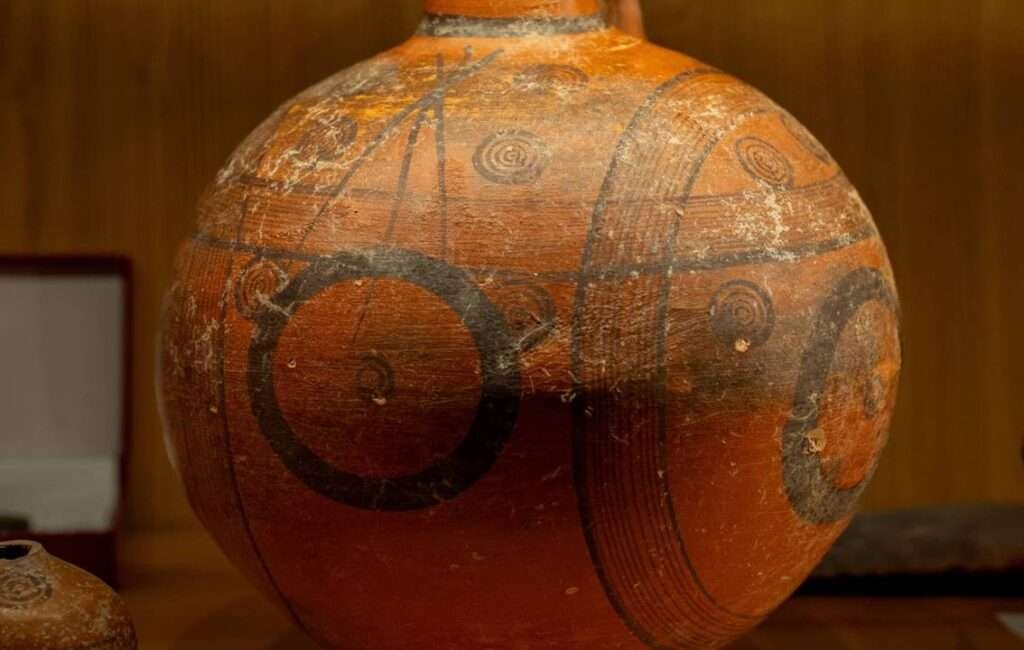
Red Polished Ware: A hallmark of the Early Bronze Age, vessels from this period likely served as funerary ritual pieces across the island. Featuring a lustrous, fiery red-orange surface, potters often moulded small, 3D scenes onto their designs. These included tiny humans and animals, such as deer and oxen.
Playful Shapes: This era saw a boom in complex, whimsical forms. These included multi-necked jugs and fused composite vessels that inccluded and bird-shaped flasks.
Foreign Influences: Heavy trade with Mycenaean Greece by the Late Bronze Age introduced several foreign motifs. These included stylised bulls and chariots that adorned magnificent wine-mixing bowls, also known as kraters.
The Iron Age: Precision and Geometry (c. 1050–310 BC)
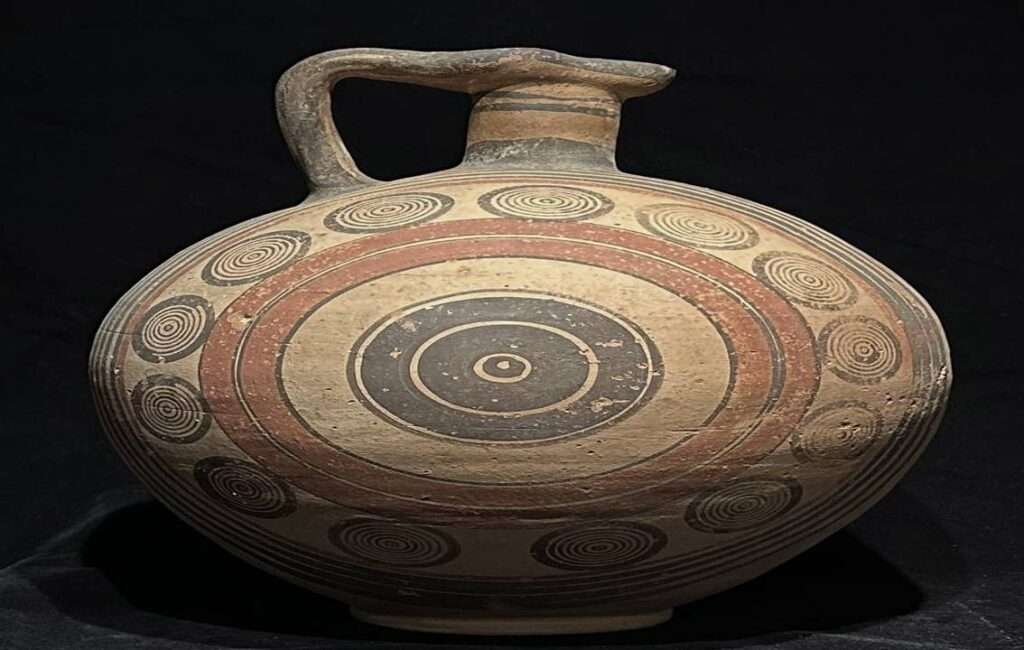
White Painted & Black Slip Wares: Characterised by precise, mathematical concentric circles, sharp triangles, and checkerboard patterns.
Bichrome Ware: This era birthed the famous ‘free-field’ style, where a single, bold subject, such as a large water bird, fish, or lotus flower, dominated the space of a jug. These pieces utilised both black and dark red pigments on light clay.
Hellenistic Adaptation: Local traditions began blending more deeply with standard Greek pottery styles, leaning into simpler forms and monochrome slips.