A PUBLIC HOLIDAY THAT CELEBRATES A STRUGGLE FOR FREEDOM
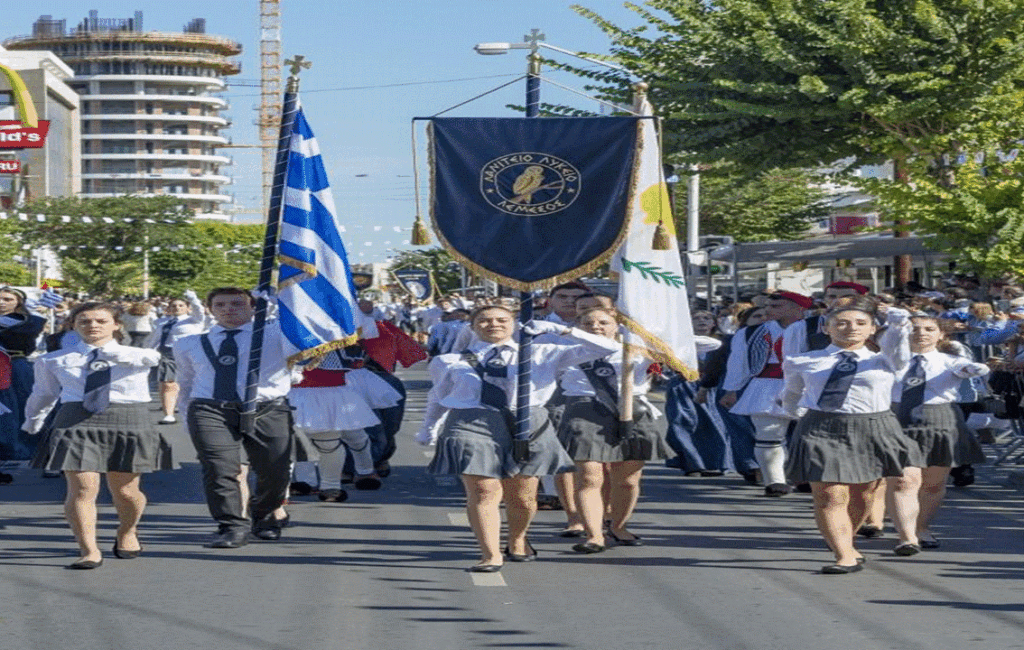
Cyprus commemorates its national day on April 1st every year. This marks the anniversary of the start of the island’s military struggle for independence against British colonial rule. This public holiday, as a result, commemorates and honours this struggle. Despite this date being celebrated as April Fool’s Day in several other European countries, April 1st is celebrated as National or EOKA Day in Cyprus. The day has a deep meaning for most Cypriots, and celebrations on this day are usually well attended. This great day of national pride typically includes several parades, flag-hoisting ceremonies, cultural performances, and fireworks. Most institutions remain closed, and church and public remembrance services also take place on this day.
THE STORY BEHIND CYPRUS INDEPENDENCE
THE CYPRUS NATIONAL DAY
Cyprus independence was achieved in the summer of 1960. This came about after a bitter four-year military campaign against a largely defunct British Empire. Hostilities led by the military wing known as ‘Ethniki Organosis Kyprion Agoniston’, or ‘National Organisation of Cypriot Fighters’, began on April 1st, 1955. EOKA, as they became widely known, were instrumental in the overall struggle that led to Cyprus becoming a presidential republic. October 1st, which is the island’s official Independence Day, is also celebrated as a public holiday.
BRITISH ADMINISTRATION
The British Empire, seeking a base of operations in the eastern Mediterranean, took control of Cyprus in 1878. It did so after brokering an agreement with a much-weakened Ottoman Empire. The British agreed on a rather unique lease agreement for Cyprus in exchange for both military and diplomatic support for the Ottoman Empire, who were in control of the island at the time. This agreement, however, was short-lived after both empires found themselves on opposing sides during World War 1. The island was then subsequently annexed by Great Britain. It later became an official British overseas territory. The idea of self-determination or a possible unification with Greece, which became known as ‘Enosis’, then gathered momentum in the years following the end of the conflict.
ARCHBISHOP MAKARIOS III & GEORGE GRIVAS
On January 15th, 1950, a referendum organised by the Greek Orthodox Church was held across the island. This saw 95.7% of all Cypriots vote for Enosis with Greece. Archbishop Makarios III, the main negotiator and representative of the majority Greek Cypriots, constantly held conferences with both Greece and the British thereafter. Although he constantly presented the results of the referendum to British representatives, his demands for Enosis remained unlikely.
A UNION WITH GREECE
Greece, at the time, also fully embraced the idea, and several attempts were made to force the issue. Greek representatives using diplomatic means saw successive appeals to the United Nations fail. These were all subsequently vetoed, and the concept of unification once again remained unlikely.
THE FORMATION OF EOKA
George Grivas, a Greek Cypriot Nationalist leader from Greece, formed the military wing EOKA in Cyprus in 1954. This came after the latest talks were once again rebuffed and the continued failure of peaceful efforts to achieve Enosis. He then went on to spearhead hostilities that included a brutal but organised military campaign. This was firmly aimed at all supporters of the continued British presence across the island. The tactics used by EOKA included assassination, sabotage, and a form of guerrilla warfare that the British were ill-prepared for.
A MILITARY CAMPAIGN
The coordinated attack, led by George Grivas against several British military and police installations across the island on April 1st, 1955, marked the beginning of a wider military campaign. This would lead to a de facto civil war that would continue for four years. EOKA, during this time, mainly used guerrilla warfare tactics throughout their campaign. This saw them retreat to secret mountain hideouts after each attack. Several acts of sabotage and the assassination of several British officials and Cypriot collaborators also took place.
A CEASEFIRE
A ceasefire, pending talks, was eventually declared in 1959. These talks, however, would secure the framework for the island’s independence instead of Enosis. These talks directly led to the signing of the Zurich-London agreement, which established the Republic of Cyprus as a fully recognised independent state. Archbishop Makarios III was installed as the first president of the new Republic the following year.
CYPRUS NATIONAL DAY OR EOKA DAY
APRIL 1ST FACTS
Historical Significance: This public holiday commemorates the start of the Cypriot national liberation struggle against British colonial rule, which began on April 1st, 1955.
The Movement: Led by Georgios Grivas, this day marks the first strike made by EOKA. Several coordinated attacks on the evening of April 1st, 1955, launched a greater armed military campaign against all British forces and installations in Cyprus.
The Goal: Although this military campaign ultimately paved the way for the island’s independence in 1960, the original aim of the struggle was Enosis. This advocated for a union with Greece, which was deeply resented by the Turkish Cypriot minority on the island at the time.
Distinction from Independence Day: While April 1st marks the beginning of the struggle, Cyprus celebrates its actual achievement of sovereignty on October 1st. This is celebrated as the island’s Independence Day each year.
HOW IS IT OBSERVED?
Closures: Most government offices, banks, schools, and large shops are closed during this public holiday.
Ceremonies: Official memorial services are held in churches and at monuments to honour the fallen fighters.
School Events: In the days leading up to the holiday, schools hold special events to educate students on the sacrifices made during the 1955–1959 struggle for independence.
Traditions: It is common to see Greek and Cypriot flags flown at several ceremonies that culminate in marches across the island. The Museum of the Struggle for Independence, in Nicosia, usually holds a special exhibition at this time.